
Getting this wrong could cost you thousands of dollars
Real Estate, Home Equity, Alberta Mortgages
HELOC vs. Refinance vs. Second Mortgage: Which Is Right for Alberta Homeowners?
Picking the wrong way to access your home equity can cost you thousands — in fees, in interest, or in a rate you didn't need to lock into. And with three different options that all technically "let you borrow against your home," it's easy to pick the one you've simply heard of most, instead of the one that actually fits your situation.
Download our free guide to see if debt consolidation is right for you here.
Choosing the Right Way to Use Your Home Equity
A HELOC gives you flexible, revolving access to funds at a variable rate. A mortgage refinance replaces your existing mortgage with a new, larger one — often at a fixed rate — but may involve breaking your current term. A second mortgage sits on top of your existing mortgage, letting you keep your current rate intact while accessing equity, usually at a higher interest rate than the other two. The right choice depends on your current mortgage terms, how much flexibility you need, and your timeline.
Here's how to actually tell them apart — and how to think through which one fits you.
Understanding Home Equity Options in Alberta
Home equity is simply the difference between your home’s current market value and what you still owe on your mortgage. In Alberta’s evolving real estate market, many households have built up substantial equity—especially those who bought before the most recent price increases or have diligently paid down their mortgage over time.
The question is not just can you access that equity, but how you should do it. Whether you live in Calgary, Edmonton, Red Deer, or a smaller community, your choice among a HELOC, refinance, or second mortgage will affect your monthly cash flow, long-term interest costs, and flexibility for years to come. It is worth taking the time to understand the trade-offs before you sign anything.
📌 Key Takeaway: In Canada, including Alberta, mainstream lenders generally allow you to borrow up to 80% of your home’s appraised value across all mortgages and home equity products combined. How you structure that borrowing is what differs between a HELOC, refinance, and second mortgage.
Download our free guide to see if debt consolidation is right for you here.
HELOC in Alberta: Flexible Access to Your Equity
How a HELOC Works
A Home Equity Line of Credit (HELOC) is a revolving credit line secured by your home. Think of it as a large, reusable credit limit that you can draw from, repay, and draw again, much like a credit card—but with substantially lower interest rates because it is backed by your property. In Alberta, HELOCs are typically offered by major banks and credit unions, often bundled with your primary mortgage under a single collateral charge.
Pros of a HELOC for Alberta Homeowners
High flexibility: Borrow only what you need, when you need it, and repay early without penalties in most cases.
Interest-only minimum payments: Minimum payments are often interest-only, which can help with short-term cash flow during renovations or temporary income dips.
Revolving access to funds: Once approved, you do not need to reapply each time you need money for a project or investment, as long as you remain within your limit.
No need to break your existing mortgage: You can often add a HELOC without changing a competitive fixed-rate mortgage you already have.
Cons and Risks of a HELOC
Variable interest rate: Your cost of borrowing can rise if the prime rate increases. In a tightening rate environment, payments can become significantly higher over time.
Discipline required: Easy access to funds can tempt some households to overspend, especially when interest-only payments feel manageable in the short term.
No fixed amortization: Because there is no built-in schedule to pay off the principal, it is possible to carry HELOC debt for many years if you do not create your own repayment plan.
💡 Pro Tip: A HELOC can be a powerful tool when used for productive purposes—such as value-adding renovations or consolidating high-interest debt—but it can be risky if used to finance lifestyle spending with no clear repayment strategy.
A HELOC Is Best When
A HELOC is best for homeowners who want ongoing access to funds rather than a single lump sum — for example, covering irregular expenses, funding a renovation in stages, or having a financial cushion available without committing to borrowing it all upfront.

Refinancing Your Mortgage in Alberta: Restructuring for the Long Term
What Is a Mortgage Refinance?
A refinance replaces your existing mortgage with a new one. In Alberta, this usually means increasing your mortgage balance up to a maximum of 80% of your home’s appraised value and using the difference to achieve specific goals—such as consolidating higher-interest debt, funding major renovations, or restructuring your payments.
Unlike a HELOC, which is a revolving line of credit, a refinance gives you a lump sum and sets a new term, interest rate, and amortization schedule. You then repay that amount over time through regular blended payments of principal and interest.
Download our free guide to see if debt consolidation is right for you here.
Why Alberta Homeowners Refinance
According to the 2026 CMHC Mortgage Consumer Survey, the leading reasons Canadians refinance include:
Home improvements and renovations (32%) – for example, finishing a basement in Edmonton or updating a kitchen in Calgary.
Debt consolidation (19%) – rolling higher-interest credit cards, personal loans, or car loans into a lower-rate mortgage.
Lowering monthly mortgage payments (14%) – often by extending the amortization or moving to a lower rate (CMHC 2026 Survey).
Nearly half of borrowers refinance before their mortgage term ends, often accepting a prepayment penalty in exchange for the benefits of a new structure. Others wait until renewal to avoid penalties and negotiate better terms with their existing or a new lender (whatsyourshare.ca).
Pros of Refinancing in Alberta
Potentially lower interest rate: Replacing a higher-rate mortgage with a lower-rate product can reduce your total interest paid over time, even if your balance increases slightly for debt consolidation or renovations.
Predictable payments: Fixed-rate refinancing gives you stable payments for the term, which can be reassuring in an uncertain rate environment.
Structured payoff: Unlike a HELOC, your refinance has a clear amortization schedule, helping ensure your debt declines over time.
Debt consolidation opportunity: Combining multiple high-rate debts into your mortgage can simplify your finances and reduce your monthly obligations.
Cons and Considerations for Refinancing
Prepayment penalties: Breaking a fixed-rate mortgage early can trigger substantial penalties, particularly with major banks. You must compare the penalty cost with the expected savings from refinancing.
Closing costs: Legal fees, appraisal costs, and potential discharge fees can add up. Some lenders offer “no-fee” refinances but may build those costs into the rate.
Longer amortization: Extending your amortization back to 25 or 30 years lowers your payment but may increase total interest paid over the life of the loan.
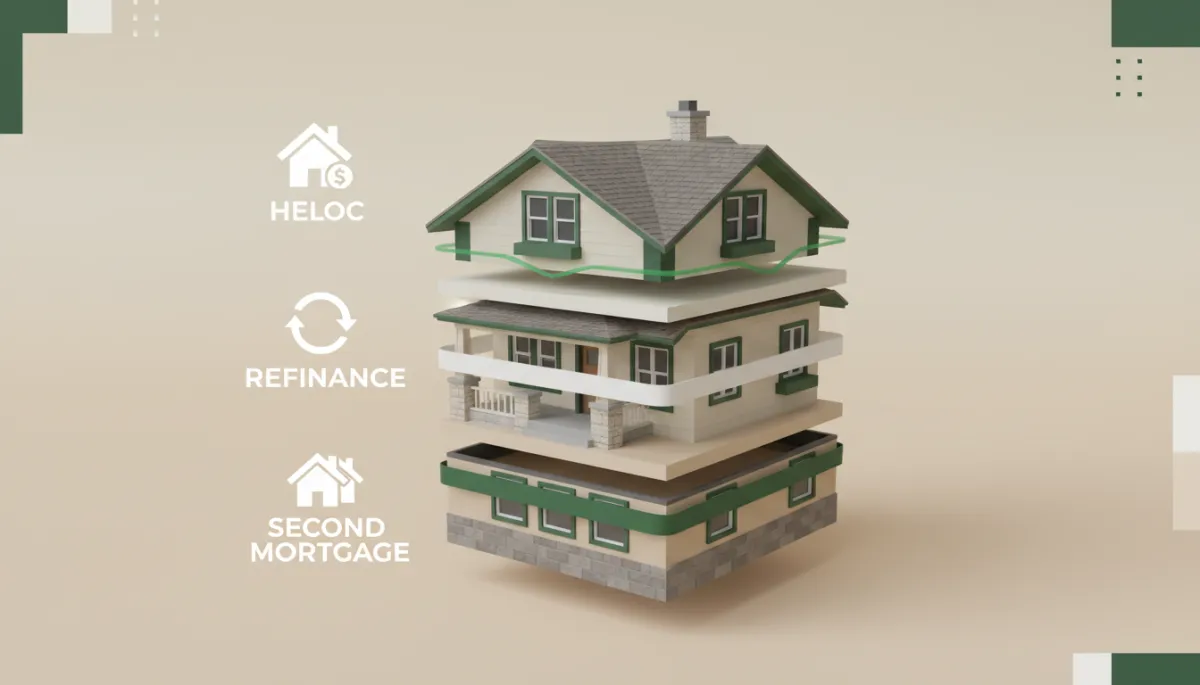
Structuring your home equity correctly can balance flexibility, cost, and long-term security.
Download our free guide to see if debt consolidation is right for you here.
Second Mortgages in Alberta: Niche but Powerful Tools
What Is a Second Mortgage?
A second mortgage is an additional loan registered against your property, subordinate to your first mortgage. It does not replace your existing mortgage; instead, it sits behind it on title. If the property is ever sold under power of sale or foreclosure, the first mortgage gets paid out before the second mortgage receives any proceeds. That added risk to the lender is why second mortgages typically come with higher interest rates than first mortgages (Financial Consumer Agency of Canada).
Regulatory Framework in Alberta
In Alberta, all mortgages—including second mortgages—are registered under the Land Titles Act in a Torrens system. The order of registration determines priority: the first registered mortgage generally has the first claim on the property, followed by the second, and so on (alberta.ca).
Standard charge terms filed by major lenders in Alberta clarify that a second mortgage is additional security and cannot override prior encumbrances (CIBC Standard Charge Terms). Many second mortgage lenders also require that you do not increase or re-borrow on your first mortgage without their written consent, because doing so can affect their security position (Equitable Bank).
From a federal perspective, total borrowing across your first and second mortgages typically cannot exceed 80% of your home’s value, mirroring the limits on standard refinances (canada.ca). Consumer protection rules in Alberta, including high-cost credit regulations, may apply if interest rates exceed certain thresholds (32% or more), but most mainstream second mortgages fall below that level (alberta.ca).
When a Second Mortgage Might Make Sense
You have a very attractive first-mortgage rate: If your existing fixed rate is significantly below current market rates, refinancing might be expensive once penalties are factored in. A second mortgage can access equity without disturbing that low-rate first mortgage.
Your credit profile has weakened: If your credit score has dropped since you obtained your first mortgage, you may not qualify for a favorable refinance. Some alternative lenders are willing to offer second mortgages at higher rates to bridge a short-term need.
You need funding quickly: Certain private or non-bank lenders can approve second mortgages faster than traditional refinances, which can be valuable for time-sensitive situations such as business opportunities or urgent debt payoff.
Pros and Cons of Second Mortgages
Pros: Preserve a low first-mortgage rate, access equity when conventional refinancing is not available, and potentially faster approval through alternative lenders. Some products offer flexible terms and longer amortization (for example, up to 35 years with certain specialty lenders) (MCAN Financial).
Cons: Higher interest rates than first mortgages, additional legal and lender fees, and increased risk in a downturn because your home carries more debt. In a foreclosure scenario, the second mortgage is more vulnerable, which is why lenders price in that risk. Through private lender, second mortgage is mostly used as a short-term solution and should NOT be considered if there is no clear full repayment strategy within a short time period.
⚠️ Warning: Second mortgages can be useful short-term tools, but they should be approached with caution. Always model your worst-case scenario—such as a job loss or interest rate increase—before taking on additional secured debt.
Special Considerations for Alberta Seniors and Near-Retirees
For older Alberta homeowners, accessing equity must be balanced against preserving long-term housing security. The province offers programs such as the Seniors Home Adaptation and Repair Program (SHARP), which provides low-interest home equity loans (up to $40,000) at a rate around 4.45% to help seniors adapt or repair their homes (alberta.ca).
Reverse mortgages, such as the CHIP Reverse Mortgage, are another specialized option for seniors who are “house rich but cash poor.” These products allow you to access equity without making regular payments, with the loan typically repaid when the property is sold (Home Equity Bank). While not the focus of this article, they are part of the broader conversation about how Alberta homeowners can use their home equity responsibly in retirement.
Download our free guide to see if debt consolidation is right for you here.
Which Option Is Right for you as an Alberta Homeowners?
Start with Your Objective
The best choice depends less on the product itself and more on what you are trying to achieve. Ask yourself:
Do you need ongoing access to funds for projects over several years? A HELOC may be ideal.
Are you looking for a single large amount to consolidate debt or complete a major renovation? A refinance is often more cost-effective.
Is your current mortgage rate exceptionally low, or are you facing credit challenges that make refinancing difficult? A second mortgage may be a practical, if more expensive, bridge solution.
Consider Your Risk Tolerance and Time Horizon
If you are risk-averse and value predictable payments, a fixed-rate refinance will likely feel more comfortable than a variable-rate HELOC. On the other hand, if your income is stable and you can handle potential rate increases, a HELOC’s flexibility may outweigh its interest rate risk—especially if you plan to repay the balance quickly.
Your time horizon matters as well. For a short-term need—such as covering a few months of expenses between jobs—accessing a HELOC and paying it off within a year may cost less than a full refinance. For a long-term project, such as financing a rental suite or major energy-efficiency upgrades, a refinance with a fixed term and clear amortization may be more appropriate.
Run the Numbers Carefully
Before choosing any option, compare:
The total cost of borrowing over your expected timeframe, including interest, penalties, legal fees, and appraisal costs.
The impact on your monthly cash flow—will the new structure relieve pressure or create strain?
How each option affects your long-term equity position and retirement plans, especially if you are planning to downsize or stop working in the next decade.
💡 Pro Tip: Use reputable Alberta-focused calculators to estimate your usable equity, penalties, and potential savings, then bring those estimates to a licensed mortgage professional to validate assumptions and explore lender-specific options.
Practical Scenarios for Alberta Homeowners
Scenario 1: Young Family Planning Ongoing Renovations
A young family in Airdrie has a competitive 5-year fixed mortgage at 3.1% with three years remaining. They plan to complete several renovation projects—landscaping this summer, a basement next year, and a kitchen update in three years. Breaking the mortgage now would trigger a sizable prepayment penalty. In this situation, adding a HELOC behind their existing mortgage could provide flexible funding over time without sacrificing their low fixed rate. The key is to maintain a disciplined plan to repay the HELOC as each project is completed.
Scenario 2: Edmonton Homeowner Consolidating High-Interest Debt
An Edmonton homeowner carries a first mortgage at 4.6% with only six months left in the term, plus $45,000 of credit card and personal loan debt at rates above 18%. In this case, waiting until renewal and executing a refinance to roll those high-interest balances into a new 5-year fixed mortgage around 4% could dramatically lower monthly payments and total interest costs. A HELOC would not provide the same structured payoff, and a second mortgage would likely be more expensive than a standard refinance.
Scenario 3: Self-Employed Borrower with Excellent First-Mortgage Rate
A self-employed Calgarian locked in a 2.0% fixed mortgage in 2021. Since then, income has become more variable and reported taxable income is lower, making it harder to qualify under traditional refinance guidelines. They need $80,000 for a business expansion. In this case, a second mortgage from an alternative lender could access the necessary funds while preserving the ultra-low first-mortgage rate. The borrower should have a clear exit plan—such as refinancing both mortgages together once income stabilizes—to avoid carrying the higher-rate second mortgage longer than necessary.
Final Thoughts: Making a Confident, Informed Choice
For Alberta homeowners, the decision between a HELOC, refinance, and second mortgage is not one-size-fits-all. Each tool serves a distinct purpose: HELOCs offer flexibility and ongoing access, refinances provide structure and often the lowest long-term borrowing cost, and second mortgages fill gaps when conventional solutions are impractical or too costly to implement.
Whatever path you are considering, approach your home equity with the same seriousness you would bring to any major investment decision. Clarify your goals, understand the rules that apply in Alberta, compare realistic scenarios, and seek professional guidance before committing. Used wisely, your home equity can be a powerful, stable foundation for renovations, debt relief, business opportunities, or retirement planning. Used carelessly, it can increase your vulnerability in the face of economic or personal setbacks.
By taking a measured, professional approach and aligning your choice—HELOC, refinance, or second mortgage—with your specific circumstances and risk tolerance, you can make your Alberta home work harder for you while still protecting what is likely your largest and most important asset.
Download our free guide to see if debt consolidation is right for you here.